
Loading the latest stories…
Changing your tie-up and treadling so that you can walk your treadles may make you enjoy weaving more and may also be better for your body.
Liz Moncrief4 min read
The subject of treadling comes up in my workshops, and I confess I’m usually the one to raise the issue. It surprises me when I see students treadling in the manner that they learned as “traditional” because it didn’t occur to them that there may be a better way. The method that I use has been around for a long time, though it doesn’t seem widely known.
Before I get into specifics, I want you to first think about ergonomics. Our bodies are well-balanced, and the pelvis is constructed for smooth movement of the legs. The hip joint rotates enough to give an adult a comfortable stride of 10 to 20 inches forward, backward, and to the side. Now this may sound basic, but if you consider your walking cadence, you don’t walk forward with your left foot for three steps and then your right foot for the same number of steps. Yes, it’s stating the obvious, but I see weavers on floor looms doing this very thing.
Your left foot starts on the far-left treadle, which you’ve designated as treadle 1, with the next as treadle 2, and so on. In the case of a six-treadle loom, you’re treadling 1, 2, 3 with your left foot working from the left toward the middle, and then your right foot takes over at 4, 5, 6 from the middle working toward the right.
This sort of movement does many things, and few of them are good. I challenge you to put a sample warp on your loom and go through these motions to see them in action.
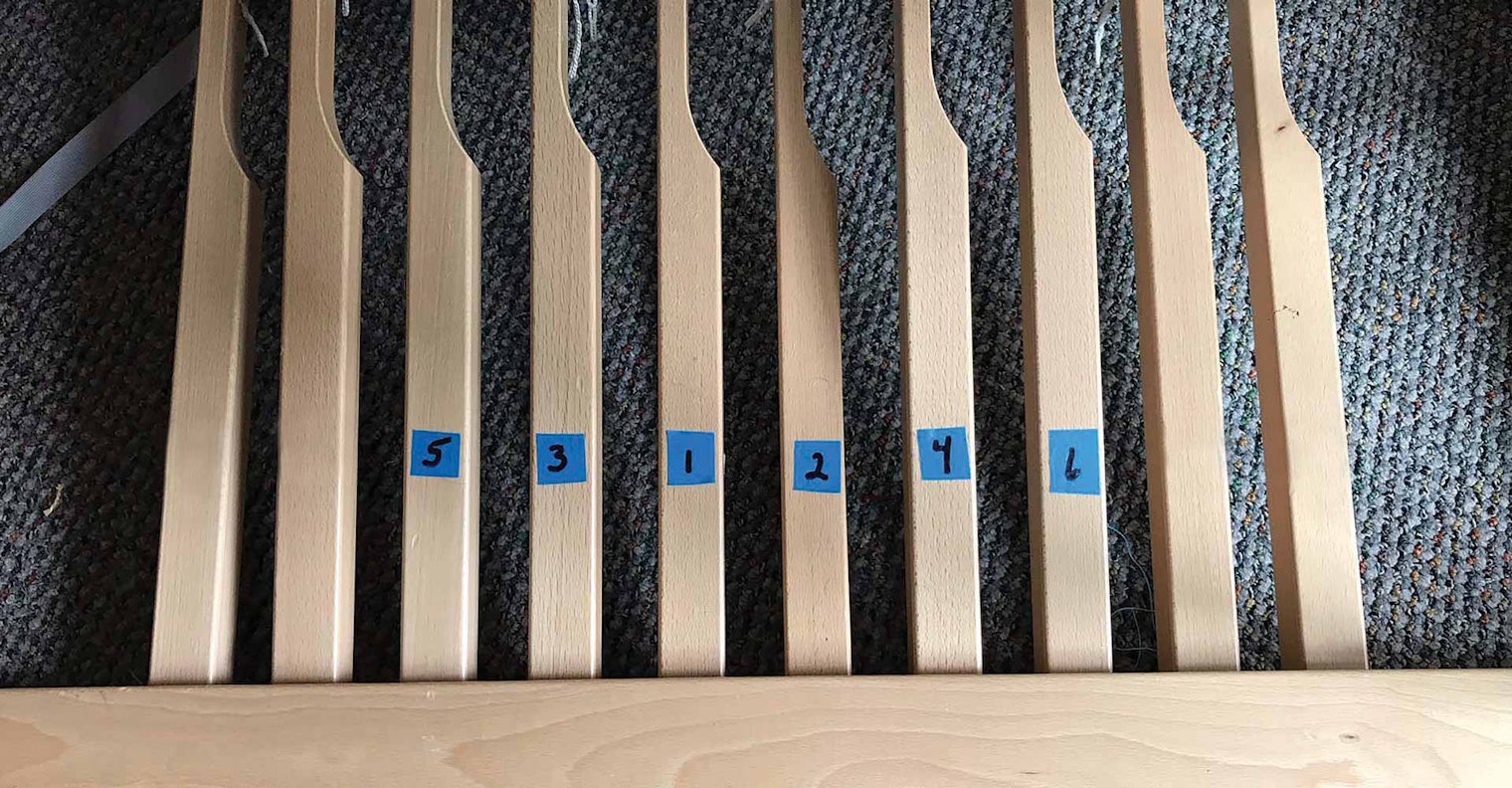
Now that I’ve identified some of the issues that can result from the traditional treadling method, let me see if I can talk you, or perhaps walk you, through making some changes. I’ve included a photo of the treadles on one of my looms with numbers taped on them. Don’t worry, it’s painter’s tape and is easily removed. I’ve used up to ten treadles, but here is a version for six treadles.
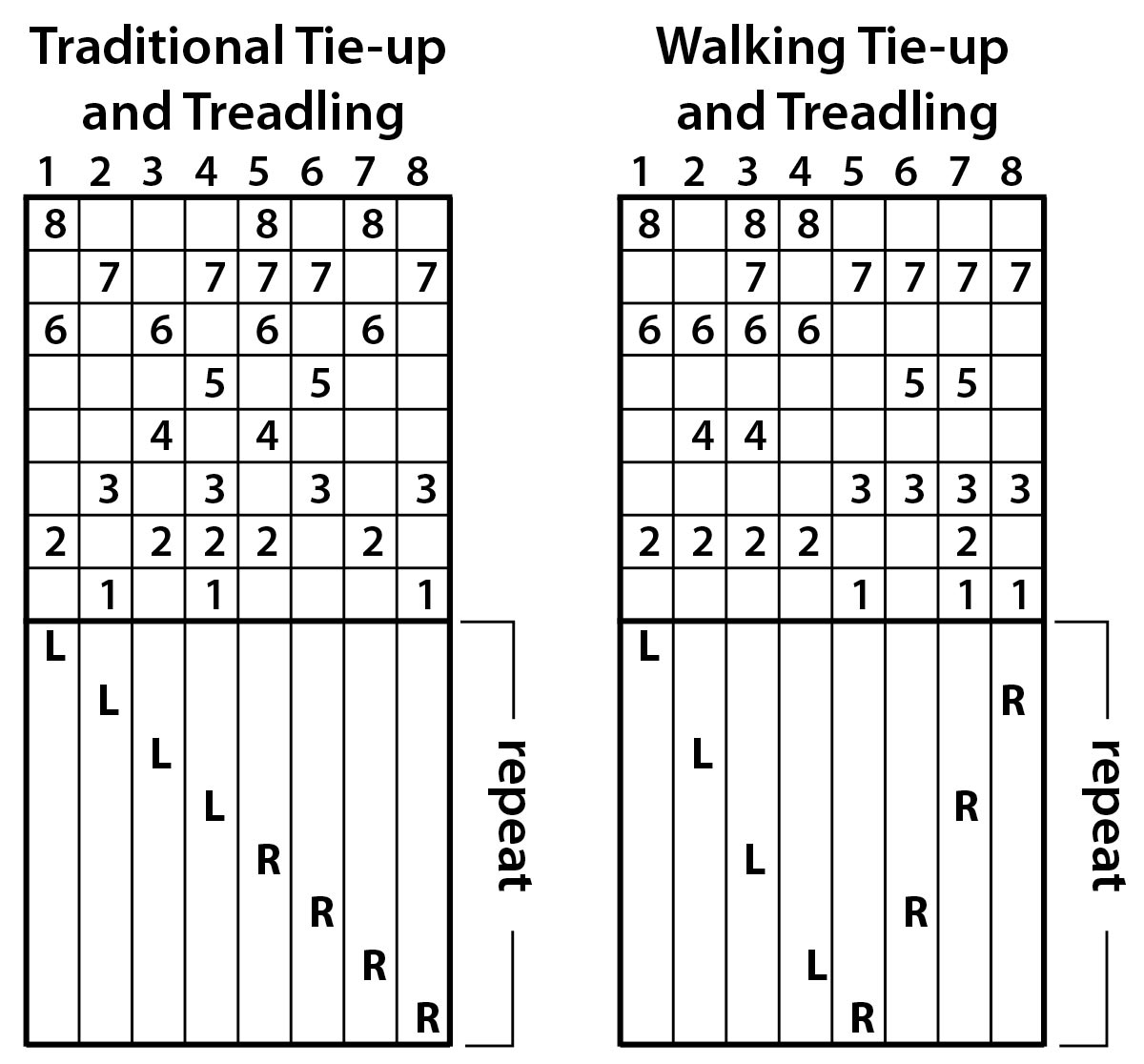
The tie-up and treadling for Andrea Williams’ draft (pages 36–38 in this issue) with both the traditional tie-up and then modified so the treadling can be walked.The treadle order was started on the outside left in the walking example.
Start in the center of the treadle board and make treadle 1 (T1) the center left, treadle 2 (T2) the center right, and so on, so that the result looks like this: T5 T3 T1 T2 T4 T6. Alternately, you can start T1 on the center right if you prefer or even on the outside of your treadle board on either side and work your way in (T1 T3 T5 T6 T4 T2).
Try a simulation of this walking method as you look at the photo. Pull out a favorite draft with a treadling sequence and step your feet in this manner starting at T1. If you happen to be treadling a 2/2 twill on four shafts, 1-2, 2-3, 3-4, 1-4, you can save yourself some weight-bearing movement by treadling a left treadle with shafts 1-2 and then shift smoothly to a right treadle for shafts 2-3, left for 3-4, right for 1-4. You have only one new shaft to lift on each consecutive treadle.
This benefit is further realized in one of my favorite advancing-twill treadlings with eight treadles in this order: T1 raises shafts 1-2-3-5; T2 is for shafts 2-3-4-6; T3 is for shafts 3-4-5-7, and so on. In this case, each new treadle is dropping only two shafts from the previous treadle and picking up two new shafts on each movement, not dropping and picking up four shafts with each new movement as would be the case if I were treadling left, left, left, left, left, and then right, right, right, right, right.
Your drafts won’t always be in sync with a straight draw or point treadling, as in 1, 2, 3, 4 or 1, 2, 3, 2, 1; however, even in complex treadlings, you won’t frequently encounter a sequence of T1 to T3 on one side or T2 to T4 on the other.
In the case of structures such as overshot that have pattern treadles that alternate with tabby on every other pick, simply place your pattern treadles on one side and your tabby treadles on the other and still maintain a left/right sequence.
The point is to make your treadling as rhythmic and balanced as possible. Check out the great YouTube video presented by Jette Vandermeiden who demonstrates the “walk,” and see if this method improves your loom time. As author and weaver Kati Meek would say, “Treadle with joy.”
Vandermeiden, Jette. “Weaving Basics: Walking the Treadles.” YouTube video, 5:52, March 26, 2014. www.youtube.com/watch?v=gGaHPQl63KU
More from Handwoven
From the Library










Comments
No comments yet — be the first to share your thoughts.
Sign in to join the conversation — commenting is for signed-in members.