
Loading the latest stories…
There are certain weavers whose work never fails to impress me, weavers who come up with designs that leave me breathless more often than not. One of those weavers is Bonnie Inouye.
Christina Garton2 min read

There are certain weavers whose work never fails to impress me, weavers who come up with designs that leave me breathless more often than not. One of those weavers is Bonnie Inouye. Known for her complex cloth, Bonnie weaves designs that I want to look at for ages, and her Jin Silk Scarf from Loom Theory: Four-Shaft Scarf Collection is no exception. Everything about the design is spectacular, from the clever use of color to the pattern that practically leaps off the scarf. Here’s what Bonnie had to say about her design:

Bonnie Inouye’s Jin Silk Scarf.
Chinese legend attributes the discovery of silk as a fiber to the Empress Hsi Ling Shih in about 3000 BCE. According to the legend, a silk cocoon fell into her teacup and began to unravel. Because she was sitting under a mulberry tree, the favored food of Bombyx mori silkworms, she didn’t have to look hard to find the cocoon’s source, and so began the history of silk.
Turned taqueté, also known as jin in ancient China, produces a fabric with clear designs and a smooth surface. The design appears as if by magic, utilizing 2 colors. Each warp floats consistently over 3 wefts, then under 1. Where one warp color is coloring one area of the design, the other warp color is dominant on the reverse side.
I always weave turned taqueté as a warp-emphasis fabric (more warp ends per inch than weft picks per inch) for a strong design and appealing drape in a stable, durable cloth. It is quick to weave but takes some extra time to warp, so I usually warp for multiple scarves. I use a weft that is thinner than the warp yarn (often much thinner), because the design comes from the warp colors. Although thin, the weft still has an impact as it blends with each of the warp colors, so I allow extra warp for sampling. A weft color that is a complement of either of the warp colors may produce iridescence in the woven cloth.
Silk is a perfect choice for iridescence and for drape. Silk scarves are warm in winter and comfortable when the weather is warmer, and they always feel good against the skin. Because the weft color can shift the appearance of each warp color, I chose hems to finish the ends rather than twisted fringe. With this structure, it is possible to weave 2 separate layers of plain weave in a tubular fashion. Folding the layers inward and handstitching the edges together creates a striking finish. I combined one of the 20/2 silk warp threads with the 60/2 silk weft to create the right color blend with a good weight for the doubleweave hems.
Happy Weaving!
Christina
STRUCTURE: Turned taqueté.
EQUIPMENT: 4-shaft loom, 11" weaving width; 10-dent reed; 2 shuttles; 2 bobbins.
YARNS: Warp: Kiku 20/2 bombyx silk (5,000 yd/lb; Treenway Silks).
WEFT: Myōjō 60/2 bombyx silk (15,000 yd/lb; Treenway Silks).
FINISHED SIZE: 8½" x 72" with ½" doubleweave hems.
More from Handwoven
 Jin Silk Scarf 16-ShaftEvery once in a while a project comes along that makes me wish I had 16 (or more!) shafts. Bonnie Inouye’s truly spectacular Jin Silk Scarf from Handwoven Loom Theory: Eight and Over Eight Scarf Collection immediately made me wish I had 16 shafts.Christina Garton · October 10, 2018
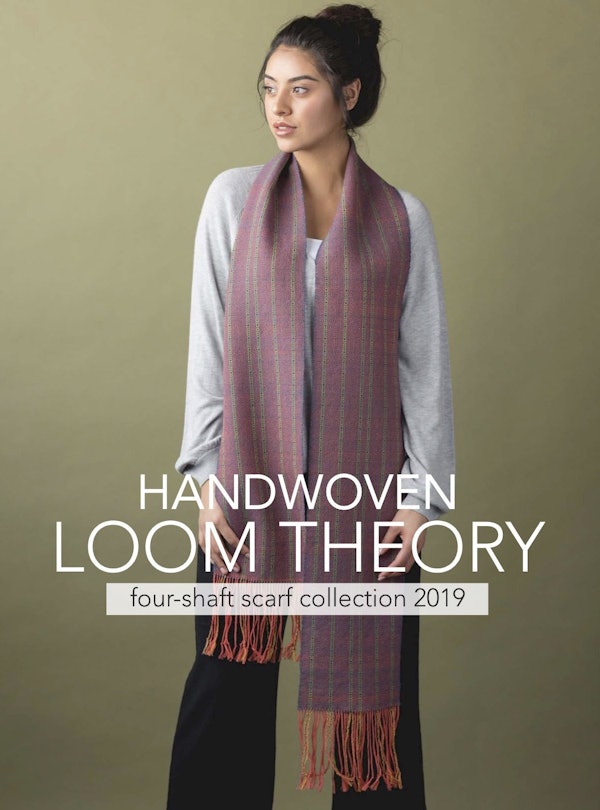
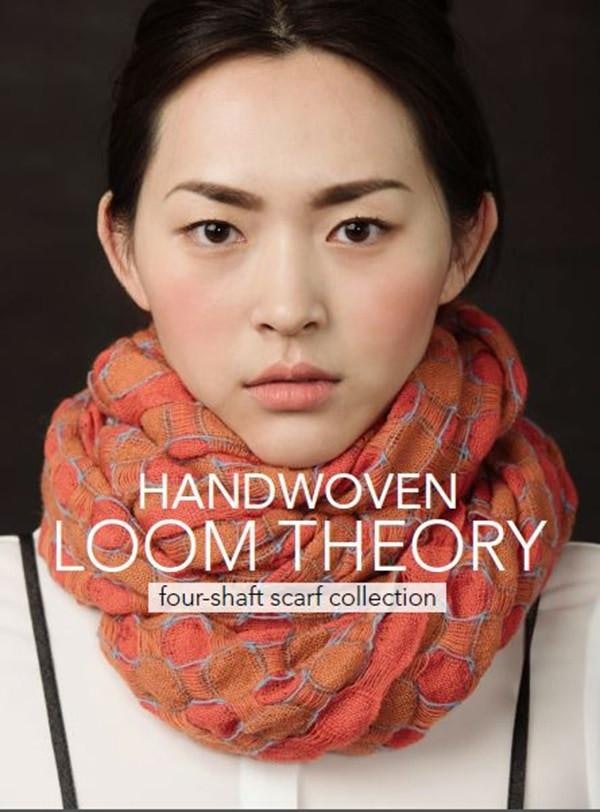
 Discover Loom Theory: Four-Shaft Scarf Collection from Handwoven
From the Library





Comments
No comments yet — be the first to share your thoughts.
Sign in to join the conversation — commenting is for signed-in members.