
Loading the latest stories…
When Judith Shangold told me she wanted to weave a shawl using the hatching technique, I was intrigued—and a little worried. Hatching is a traditional tapestry technique, and when I think tapestry, I don’t think of fine shawls with great drape.
Christina Garton1 min read
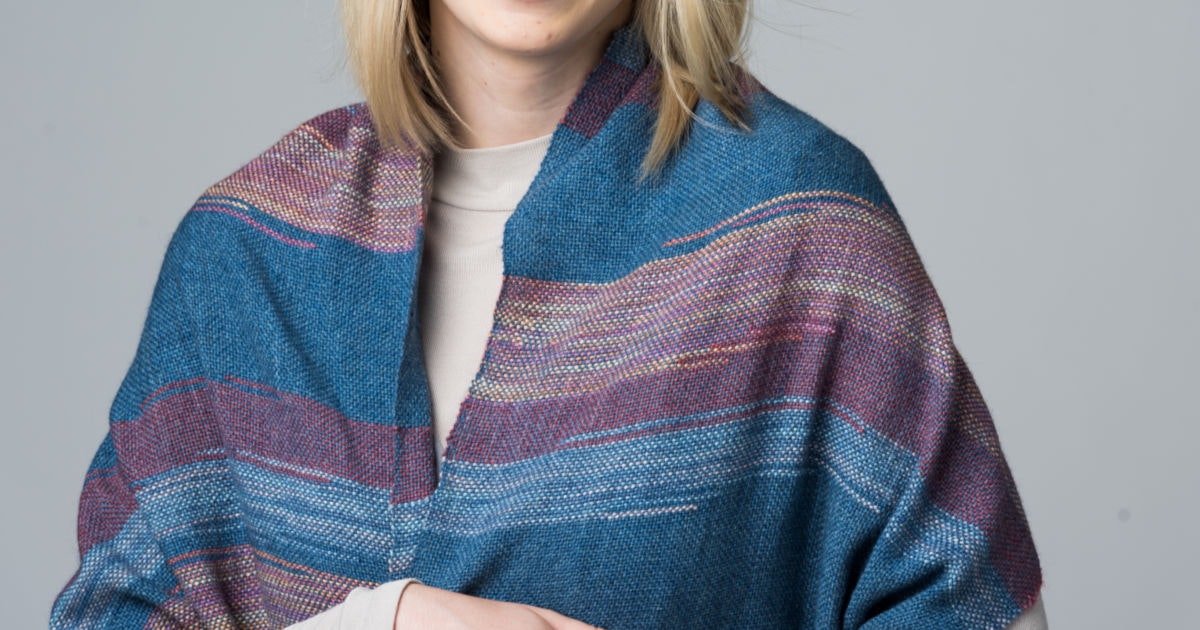
When Judith Shangold told me she wanted to weave a shawl using the hatching technique, I was intrigued—and a little worried. Hatching is a traditional tapestry technique, and when I think tapestry, I don’t think of fine shawls with great drape. Oh, how wrong I was! Her Sunset Shawl, from Handwoven Loom Theory: Rigid-Heddle Scarf Collection, is spectacular. The hatching gives Judith’s shawl an elegant, painterly effect, and the Serena yarn in the warp and weft is fine enough to create fabric that drapes and flows. Here’s what Judith had to say about her design.

Judith Shangold used the hatching technique to create a shawl that looks like a painting. Caleb Young (Good Folk Photography)
Hatching, hachure in French, is a tapestry technique. When utilized in a balanced weave, this simple technique creates a painterly effect. You can be very freeform with it or create a structured pattern. For this shawl, I designed two bands and alternated them, separating the bands with a few inches of a solid color. Follow the directions to re-create what I have done or design your own “painting.”
Happy Weaving! Christina
PROJECT TYPE: Rigid-heddle.
STRUCTURE: Plain weave with hatching.
EQUIPMENT: Rigid-heddle loom, 20" weaving width; 12- or 12.5-dent heddle; 2 shuttles and 4 bobbins or 4 stick shuttles.
YARNS: Serena (60% baby alpaca/40% pima cotton; 170 yd/50 g; 1,552 yd/lb; Manos del Uruguay; Fairmount Fibers).
FINISHED SIZE (after washing): 16 ½" x 68" with 6" fringe.
More from Handwoven
From the Library






Comments
No comments yet — be the first to share your thoughts.
Sign in to join the conversation — commenting is for signed-in members.