
Loading the latest stories…
SUBHarness
It's frustrating to love an 8-shaft pattern when you only have a 4-shaft loom. In this article from March/April 2018, Madelyn describes how to reduce 8-shaft twill drafts to 4-shafts. We tried her methods on some recent drafts, check out our results!
Madelyn van der Hoogt4 min read
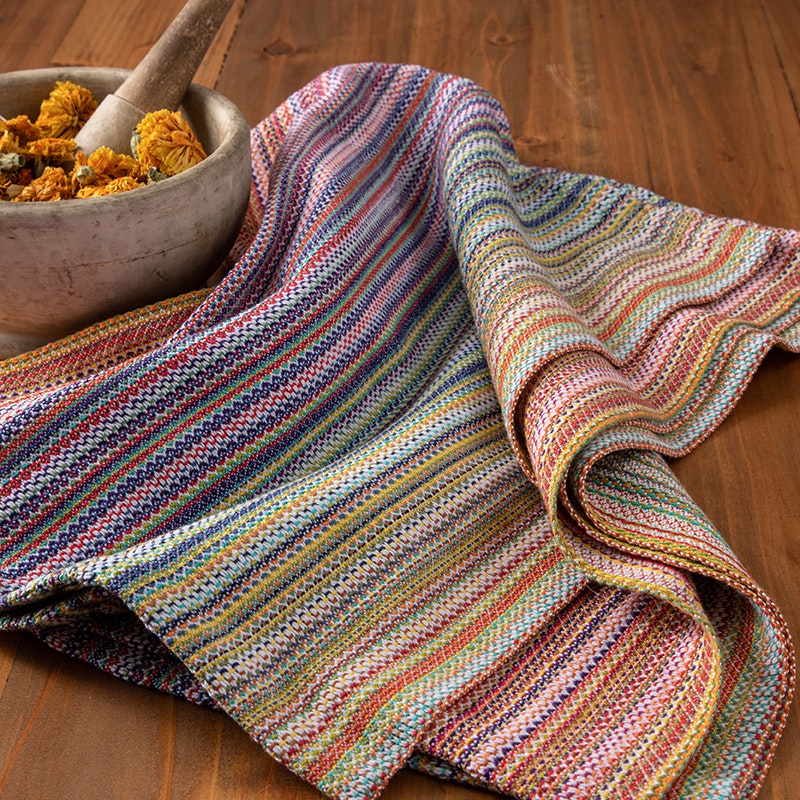
Four-shaft looms are very versatile, but sometimes you might fall in love with a handwoven fabric only to be frustrated when you realize it uses more shafts than you have available. This article by Madelyn van der Hoogt from Handwoven March/April 2018 explains how you can reduce 6- and 8-shaft twill drafts to 4-shaft versions. One of the examples she gives is an M and W twill that exactly matched Kathie Roig's Random Exchange Towels from September/October 2021, so that one was easy. Then I tried both of her methods on Annette Schipf's 8-shaft twill draft for her Stormy Days Jacket from September/October 2022.
If you are a current subscriber to Handwoven magazine, log in below to read the article and practice the techniques. Then check your results using the attached downloadable pdfs, and you are ready to branch out on your own! - Susan
 Annette Schipf's Stormy Days Jacket is an 8-shaft twill. The 4-shaft version I developed using Madelyn's methods is similar but not exactly the same. Photo by Julia Vandenoever
I bought my first loom based on the only word about it that I understood— “cherry.” I didn’t know what a harness was, how a friction brake worked, or what “weaving width” really meant. My “cherry” Norwood just happened to have four shafts. After a short while, I began to believe that more shafts meant better weaving.
As I added looms to my collection (one with as many as 32 shafts), I soon learned that more shafts do not mean better weaving. Craftsmanship, successful designs, appealing color interaction, suitable fabric textures—none of these is dependent on the number of shafts on a loom. More shafts do bring some design advantages, especially when moving from four to eight, but the advantages decrease proportionately as the number of shafts increase. The greatest advantages occur when moving from two shafts to four, not as great when moving from four to eight, even less when moving from eight to twelve, and so on. Basically, more shafts allow fancier twills and more pattern blocks.
A weaver with a four-shaft loom can take great joy in its infinite pattern potential; just leaf through Davison and Dixon and check out all the drafts for overshot, laces, and twills. This is sometimes not enough consolation, however, when you want to weave a project in Handwoven that requires eight shafts, and you only have four.
Many of these projects are likely to be woven in twill (for towels, blankets, runners, clothing, etc.). The good news is that you can reduce most multi-shaft twill designs to four shafts. The sacrifice is usually in float length: Twills on more than four shafts allow longer floats and more varied float length. Even so, you can weave similar pieces on your four-shaft loom using the project instructions.
To do this, first think of twill threadings as circular, progressing in a direction, either 1-2-3-4 (clockwise) or 4-3-2-1 counterclockwise.
More from Handwoven
 Join In: A Retreat for Weavers of All Sorts!Don’t miss the classes, community, and fun at Weave Together 2027.Handwoven Editors · July 20, 2026
 Books Off the Beaten Path: The Yarn Barn of Kansas List of Hidden GemsBook Club Podcast: What lesser-known treasures do Yarn Barn fiber artists love to share? Susan and Melissa share some of their favorites in weaving, spinning, and knitting. Liz Gipson drops by to talk about one of her books that Susan and Melissa adore.July 18, 2026
 Selvedge Series, Part 3: Add Commercial or Handmade Trims + Free VideoTwill tape, braids, and even fancy rickrack step up in this video tip from Spice Up Your Selvedges.Sara Bixler · July 15, 2026
 Books in Brief: Bandweaving, Tapestry, Artists at Work, and Wild BasketsFour new books with ideas to inspire handweavers.Handwoven Editors · July 13, 2026
 Understanding Brackets and RepeatsDon’t let yourself be overwhelmed by all the information that sits above a threading.Handwoven Editors · July 10, 2026
 How to Twist FringeTransform warp threads into a decorative feature with this finishing technique.Handwoven Editors · July 10, 2026
 Simple HemstitchingHemstitching creates a neat, secure edge that helps prevent your weaving from unraveling.Handwoven Editors · July 10, 2026
 Ladder and Trellis HemstitchingOnce you’ve mastered the basic hemstitch, try these decorative variations for an elegant edge.Handwoven Editors · July 10, 2026
 On Vacation? Feel Like Weaving? Find a Good Stick!Start with a walk in the woods, add a handful of thrums, and you’ll have a project to fill a lazy afternoon.Lynn Rognsvoog · July 8, 2026
 All Sorts of Warp Ends: Single, Doubled, and WorkingWhat do those words mean when it comes to heddles—and to sett?Handwoven Editors · July 6, 2026
From the Library


Comments
No comments yet — be the first to share your thoughts.
Sign in to join the conversation — commenting is for signed-in members.