
Loading the latest stories…
Have you ever wanted to upcycle a thrift store sweater but didn’t know how to start? Pam James explains how to ravel a sweater so you can use the yarn to weave, knit, or anything else you so desire.
Pam James4 min read
Have you ever wanted to upcycle a thrift store sweater but didn’t know how to start? In her article for the January/February 2018 issue of Handwoven, Pam James explains how to ravel a sweater so you can use the yarn to weave, knit, or anything else you so desire. With these instructions you’ll be able to upcycle sweaters into the ultimate eco yarns. And if you’re interested in more information on weaving with recycled yarns, make sure to check out our free eBook on the subject! —Christina
I admit to being cheap—or as my sister-in-law so kindly says, “resourceful.” However, the reason I weave almost exclusively with yarns from used sweaters is that I discover all sorts of unusual textures and types of yarn. You may also find yourself drawn to upcycling, be it for environmental reasons or for converting Grandpa’s favorite sweater into a shawl you can wear.
While you might not depend upon used sweaters for all your weaving as I do, the right one might provide the inspiration or spark(le) you need for your next project. Plus, a basic long-sleeved pullover yielding four large balls of yarn will probably cost you a lot less than $10. Of course, not every used sweater is worth raveling and could, in fact, prove to be pure frustration. The first step is learning how to choose a sweater.
SUGGESTED TOOLS

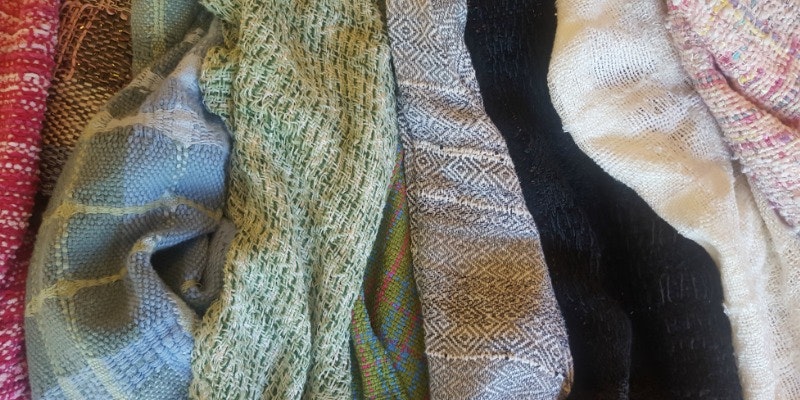
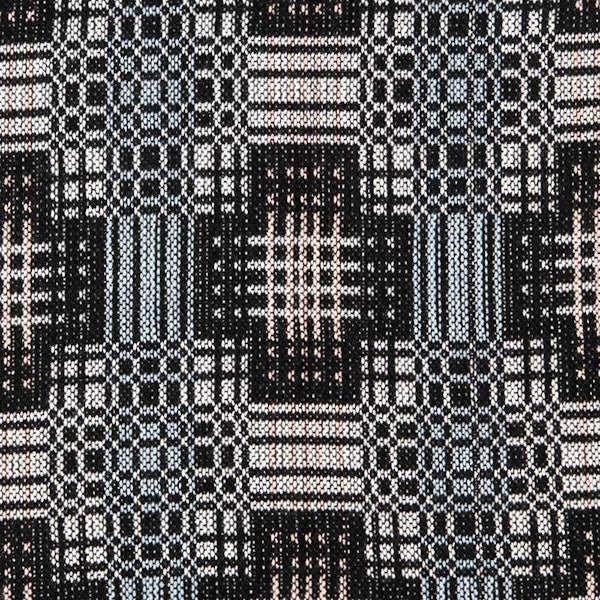
A selection of just a few of Pam’s upcycled sweater yarns.
CHOOSE THE RIGHT SWEATER
WASH THE SWEATER Before I begin disassembling, I wash the sweater. I don’t buy wool, so I put all the sweaters in a sink, run the hottest water I can on them, then run them through the dryer. If you do buy wool, make that a cool-water bath and air-dry the item. The goal is to see how the yarn responds to expected future washing so that there are no surprises later.
DISASSEMBLE THE SWEATER
RAVEL EACH OF THE PIECES You should now have a front, a back, and two sleeves. While you may create a round ball as you ravel, I find using a ball winder much faster. Begin raveling from the top of each section. You will frequently find one or two rows of knitting that are short strands before you find the end that will be continuous for the entire section. I start a new ball at every break so that I know that each ball is a continuous strand of yarn.
ADDITIONAL DETAILS A V-neck will frequently have a short strand that goes from the shoulder to the point of the V, with the opposite side being continuous to the bottom of the sweater. Separate neckbands or cuffs can be good short lengths to use for sampling. On rare occasions, you will find a sweater knitted with two yarns that alternate from row to row. Your best option is to wind the yarn into two balls simultaneously. Tuck the fiber content and brand label into the middle of your ball of yarn for future reference. My rule of thumb is that there will be enough yarn from any sweater to weave something approximately the same size. If you want a more accurate estimate, a yarn balance can help.
Most importantly, don’t get discouraged! Choose something easy to start with (fat yarn, easy-to-see chain stitching, and loose stitches) to get the idea. You will get better and better at choosing sweaters, and figuring out the deconstruction will become easier.
—Pam James
More from Handwoven
From the Library






Comments
No comments yet — be the first to share your thoughts.
Sign in to join the conversation — commenting is for signed-in members.